4 Mart 2012 Pazar

GlobaliFashion

 GlobaliFashion
Globalization is, under the control of the logic of capitalist production and consumption; becoming the uniform of the world. Rulers like to establish a world of uniform thought, production and consumption, strengthening their power and making it easier to manage society. Liberalism’s policy is making borders unclear, creating a uniform daily life. It excludes the local culture of life and instead, forms an artificial global culture.Thus, clothing of the local culture is withdrawn to the mystical and symbolic location and removed from real life.
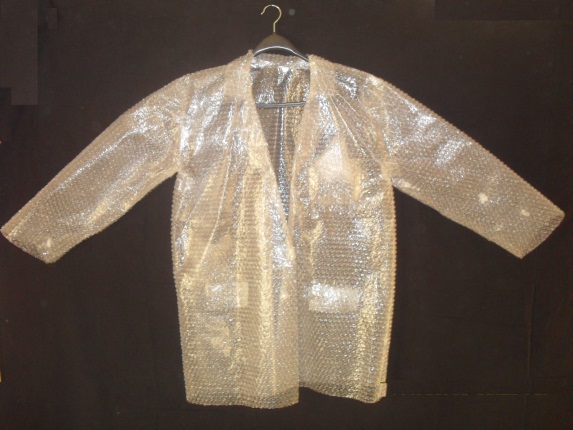
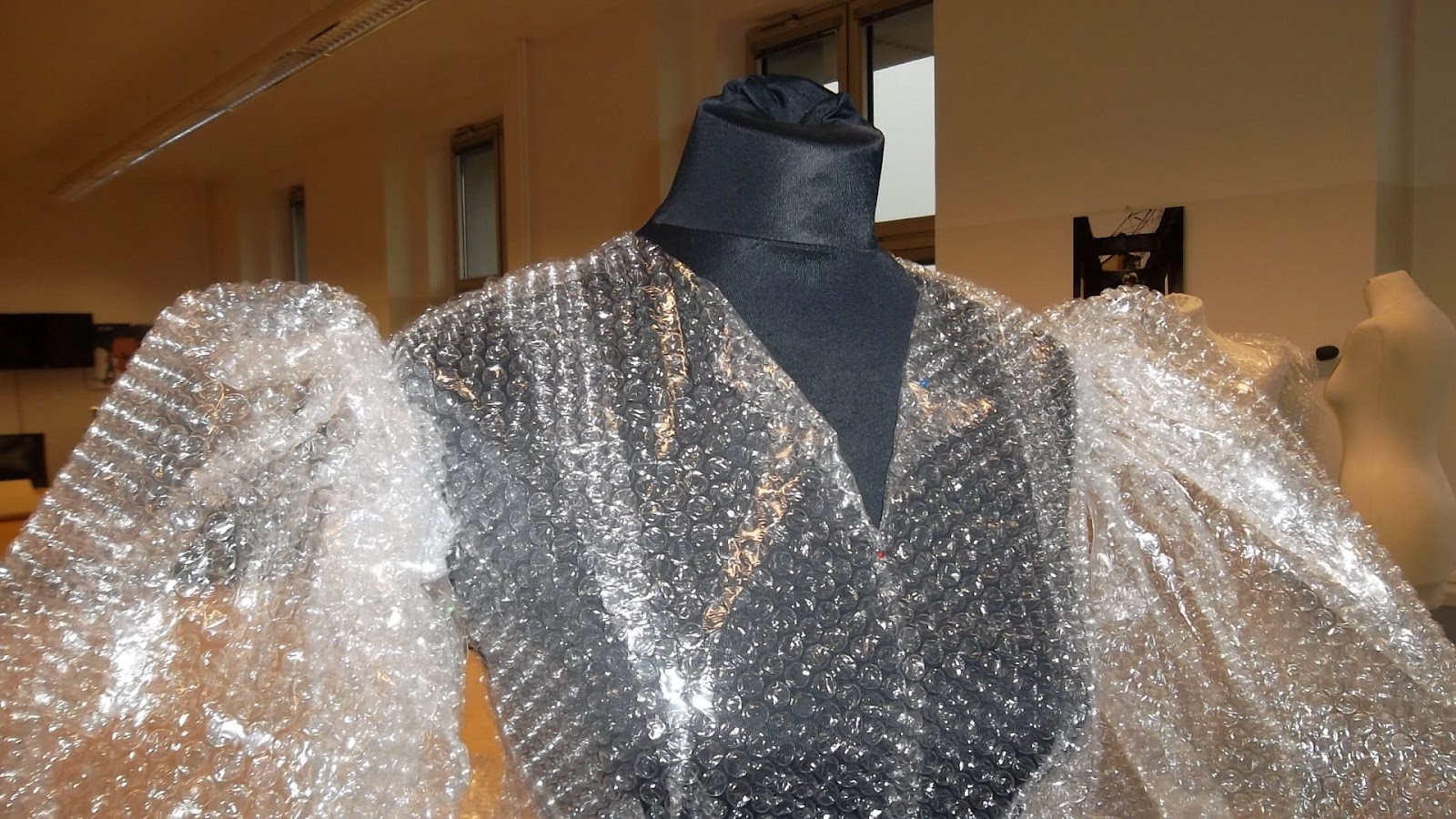
The aim of the project, “GlobaliFashion”, is to reveal the negative effects of globalization on cultural differences by sampling an ironic language
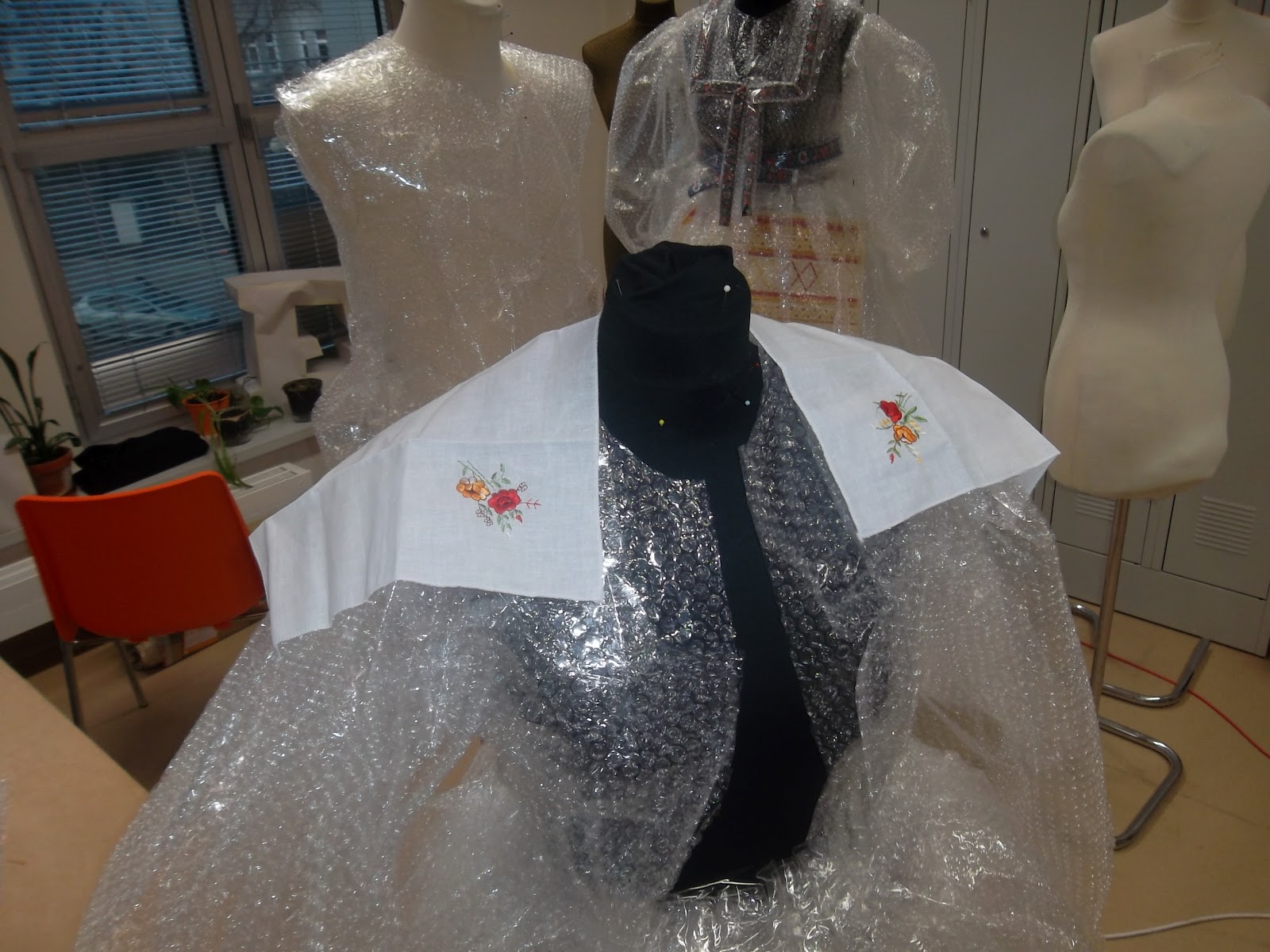
This project emphasises globalising homogeneous clothing  culture,  by using the colorless and transparent industrial product, bubblewrap. Additionally, using small particles that belong to local culture, the  culture becomes symbolic and dysfunctional. Bubblewrap is used for the safety and isolation of the person living in this unsecured situation due to unclearness of the borders.
"GlobaliFashion" will take place in different countries and regions, with the support of professionals in these places. It will be a series of responses to each different location, remaining faithful to the local culture of that place through thorough research and documentaion. The documents will be exhibited with the artworks. Thus, this project will be partly documentary.

Seçkin AYDIN, 2011

---------------------------------------------------------------------------------------------

“GlobaiFashion”

Küreselleşme; kapitalist üretim ve tüketim mantığı içerisinde ve kontrolü altında dünyanın tektipleşmesidir. Egemenler, iktidarlarını pekiştirip, toplumları daha kolay yönetebilmek için, tek tip düşünen, üreten, tüketen, beğenen daha doğrusu, tektip yaşayan bir dünya kurmaya çalışmaktadırlar. Liberalizmin, sınırları silikleştirme politikası, toplumları homojenleştirip üretim ve tüketimde küresel bir aynılaşma yaratarak günlük yaşamın tektipleşmesine, yerel kültürün  yaşam dışı bırakılmasına ve yerine yapay bir global kültürün getirilmesine neden olmaktadır.  Yerel kültüre ait olan giyim ise, mistik ve sembolik bir düzeye çekilip yaşamdan çıkarılmıştır.

"GlobaliFashion" isimli çalımanın amacı, Küreselleşmenin kültürel farklılıklar üzerindeki olumsuz etkisini, giyim kültürünün homojenleştiğini ironik bir dille örnekleyerek ortaya koymaktır. 

Bu projede, endüstriyel bir ürün olan naylonun renksiz ve saydam olması giyim kültürünün küreselleşerek homojenleştiğine, çalışmaların kenarlarına yerleştirilen yerel kültüre ait küçük parçacıklar da yerel olanın sembolikleştirilip işlevsizleştirildiğine vurgu yapmaktadır. Naylonların balonlu naylon olması ise, bu, oldukça homojen ve belirsilik ortamının yarattığı güvensizliği giderip bireyin korunma ve izole olma dürtülerini giderme amaçlıdır.

Bu sergi projesi, bir seri olarak bir kaç ülkede hatta aynı ülkenin içinde farklılık gösterilen bölgelerde yapılacaktır. Proje, her bölgede o bölgeye özgü giyim kültürüne sadık kalınarak yeniden üretilecektir. Projede yer alacak giysiler, o bölgede yapılacak araştırmalar sonucunda elde edien eski kitap ve kartpostallerdeki giysilerle birebir aynı olmasına özen gösterilecektir ve bu toplanan bilgi ve belgeler de üretilen işlerle birlikte sunulacaktır, bu yönüyle bu çalışma kısmen de olsa bir belgesel niteliği kazanacaktır.  Bu projeyi yaparken gidilen bölgedeki, konuyla ilgili kişilerden profesyonel destek alınacaktır.

Seçkin AYDIN,  2011


The Project in Czech Republic 
Çek Cumhuriyeti'ndeki Proje


The Collected Documents / Toplanan Belgeler


Me (left) and Senior Lecturer: MgA. Jan C. Löbl (right) At the Fashion and Textile Design Studio.

Jan Evangelista Purkyne University in Usti Nad Labem 
Faculty of Art and Design, Department of Fashion and Textile Design


3 Mart 2012 Cumartesi

disCONNECTING PEOPLE


-------------------------------------------------------------------------------------------------

---------------------------------------------------------------------------------


visit the exhibitin

29 Kasım 2011 Salı


Visit the exhibition

In the Homy Space; Relocalization


In the Homy Space; Relocalization.
Individuals, just like societies, need a certain past, memory, and sui generis symbol and images to continue their existences. Values and symbols obtained from social life are individualized by transforming personal approaches and preferences. This individualization is mostly supported by the individual’s habitat.

Home as an environment carries the property of being public space for the individual’s mental and sensational realm. At the same time, it is a private space where s/he personalizes experiences and knowledge acquired from the life outside the Home. Home, for the individual, is not only a shelter but also a space in which individual and collective memory are formed and accumulated. Therefore, the relation between Memory and Home is important for coming into existence of individual and social identities.

Home, which has very close contact with the concept of family, is in charge with raising individuals for other institutions for the persistence and reproduction of society. This space where society is reproduced is crucial for determining the societal role of the individual. In this respect home is a “threshold” or “in-between” place for passing from private to public space.
The individuals whose social roles are definite and competent for others might have to leave home temporally or permanently to accomplish his/her personal and social responsibilities.

Actually, the individual can not leave the Home completely because individual is identified with it, s/he has formed an identity and it is very difficult to detach from this identity. In this case, the best thing to do is to try to control relocalization while struggling with the negative effects of delocalization. In order to realize the relocalization process under the control of the individual, it is necessary to make a sense of belonging in space. In this point, memory should be carried to new space and realized in life. For that, instead of living in a space, the individual should be in a dialog with space and experience it. This prevents the individual to be scattered from the new environment in which s/he is a foreigner.

This is encoding Home with images, symbols and affects and carrying it. It is to be identified with destination, IN-HABITING and being itself.


As an Italian Jesuit priest Matteo Ricci, who was a missioner in China for long time, said four hundred years ago:
“You will build a palace for yourself and inside it you will place every word, face, knowledge and memory which you want to remember. You will design your memory as a unity. You will decide the architecture of your memory; you will set up the order of your memories. You will be the master of your past”.

This is the proof of our existence…It is the Identity.

Seçkin AYDIN
Czech Republic , October, 2011


This exhibition consist in artistic interventions to make shelters into one’s domestic space, by artists who came from different countries with temporarily exchange program.Artworks will be exhibited at their real places, at artists’ living room, bathroom, kitchen and even toilet, in the attempt to close capture real stories, real-time and real space.This takes place in a Ten-story building, on seven floors. In this way, there will be circulation at elevators, corridors and in dwellers’ apartments. Private spaces of artists will become public spaces, where people can dialogue with each other about art and life issues.

The exhibition aims to remove the whole building out of its real purpose, in other words to transform it into space itself."


Curator:
Seçkin Aydin

Artists:
Adeliina Marková (CZ)
Aida Markeviciute (LT)
Aleksandra Paluch (PL)
Alena Bušíková (SK)
André Uváèková (SK)
Ashton Haws (UK)
Damla Gül Tanrikulu (TR)
Debbie Claxton (UK)
Helena Velièová (SK)
Jacklina Jekova (BG)
Lucka Mikušová (SK)
Nikola Nikolai (CZ)
Steven Rossiter (UK)
Tib Roibu (RO)
Victor DM Rodriguez (SP)